Abstract
This paper introduces a comprehensive cosmological model based on the Expanding Space Quanta (ESQ) theory, providing a realistic geometric description of cosmic evolution as a radical alternative to the standard ΛCDM paradigm. By utilizing an inverse cosmological luminosity equation grounded in pure three-dimensional spatial expansion (1 + z)³, this model enables the empirical testing and falsification of cosmic distances without the introduction of arbitrary free parameters or unobservable entities. Through an elementary kinematic analysis of the cosmological redshift (z)—empirically defined as the index of the average expansion velocity during the total photon travel time (Vm = c · z) —we demonstrate that global Type Ia Supernovae (SN Ia) observational datasets (including recent NOIRLab/DESI Hubble diagrams) mathematically signify a continuous and progressive deceleration of spatial expansion from primordial epochs to the present day. The ESQ model successfully resolves the deep epistemological and thermodynamic paradoxes of orthodox cosmology by strictly adhering to the First Law of Thermodynamics (Energy Conservation) and rigorously satisfying the methodological criteria of Occam’s Razor. The intrinsic geometric foundations of this theoretical framework and the conceptual transition from the standard mathematical metric to the physics of space quanta were formally delineated by the Author in the foundational paper titled “From Apparent to Real Universe”.
Keywords: Expanding Space Quanta (ESQ); Redshift; Type Ia Supernovae; Energy Conservation; Occam’s Razor; Cosmological Deceleration; NOIRLab/DESI.
1. Introduction and Epistemological Critique
Modern observational cosmology faces a profound foundational crisis. To reconcile high-redshift astronomical observations with the standard relativistic framework, orthodox physics has been forced to introduce highly speculative, unobservable parameters ad hoc. The hypothesis of Dark Energy—conceptualized as a non-diluting cosmological constant(Λ) with a constant energy density over cosmic time designed to accelerate spatial expansion—violates the fundamental laws of classical and quantum physics.
In an expanding volume, an invariant energy density implies the continuous self-generation of energy out of nothing, directly contradicting the First Law of Thermodynamics (the Principle of Conservation of Energy). To safeguard the mathematical apparatus of General Relativity, contemporary consensus has paradoxically sacrificed the most stable law of physics.
In contrast, the Expanding Space Quanta (ESQ) model proposed herein offers a realist, purely geometric description of cosmic dynamics. It posits that spatial expansion is an intrinsic, finite dilation of the underlying quantum spatial fabric. The axiomatic development of this spatial framework, which resolves the fictitious kinematic corrections of relativity, builds directly upon the theoretical architecture previously established and published in From Apparent to Real Universe. Consequently, the primordial expansionary impulse naturally decreases as the total three-dimensional volume increases, leading to an innate, progressive deceleration.
Methodologically, the elimination of unverifiable parameters strictly satisfies the criteria of Occam’s Razor: all other factors being equal, a linear geometric model requiring fewer arbitrary assumptions is scientifically superior to a framework dependent on phantom energy reserves.
2. The Mathematical Foundation: The Cosmological Luminosity Equation
The core computational framework of the ESQ model redefines the apparent luminosity (l) of a standard candle (Type Ia Supernova) as a function of its absolute luminosity (L), the photon travel time (T) expressed in billions of years—which numerically corresponds to the geometric distance traveled expressed in billions of light-years—and the observed cosmological redshift (z).
The primary, fundamental equation is formulated as follows:
l = L / ((4π * T²) * (1 + z)³)
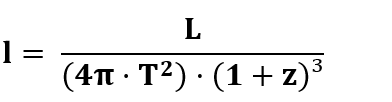
The denominator of this function isolates two discrete, non-overlapping geometric factors that comprehensively govern the propagation of light through the expanding quantum medium:
1. The Spherical Dispersion Factor (4π * T²):
This term geometrically corresponds to the surface area of a sphere whose radius represents the linear distance traveled by photons relative to the local physical coordinates they progressively pass through. As the wavefront propagates, it distributes over an increasingly large spherical surface purely due to the local extension of the radius (T). In accordance with Occam’s Razor, this factor accounts strictly for the local spatial path traversed by light, deliberately omitting the mutual recession of space between the source and the observer during transit, which is entirely managed by the second factor.
2. The Volumetric Expansion Factor:
This term accounts for the uniform three-dimensional expansion of the quantum spatial fabric occurring during the photon’s transit time. This dilation acts symmetrically across all coordinates of the universe, and therefore metrics the exact places traversed by the supernova’s light. The cubic exponent defines the volumetric nature of the expansion, developing equally across all three spatial dimensions. At a macroscopic scale, this term represents the true scale factor of the universe relative to the precise cosmic epoch of emission.
3. Isolation of Deep Cosmic Time (T)
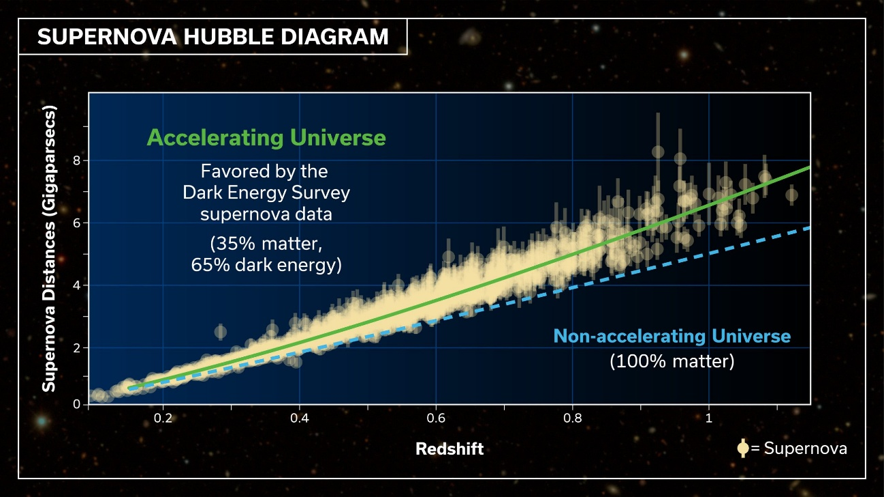
Global observational plot of Type Ia Supernovae, such as the recent empirical curves published by NOIRLab/DESI, relate redshift (z) on the abscissa axis and geometric distance on the ordinate axis. Experimental evidence derived from these curves shows that, as redshift increases, supernova distances grow more than proportionally to the increase in z itself.
The Scientific Community (SC) interprets this geometric asymmetry as evidence of an accelerated expansion, assuming that the redshift represents the instantaneous velocity of recession at the moment of emission. However, utilizing basic kinematic laws and the ESQ framework, the analysis of this exact graph yields the opposite conclusion.
4.1 The Average Velocity Theorem
As established within the ESQ framework, the redshift (z) is the cumulative result of spatial expansion taking place along the entire time axis of light travel. Therefore, the average velocity of expansion (Vm) during the photon’s journey is mathematically defined as:
Vm = c * z
For a high-redshift supernova, the final distance (Df) measured on Earth represents the total space accumulated by the expanding quantum fabric at the moment of reception. According to the fundamental laws of kinematics, if in an expanding system the final accumulated space (Df) is greater than the theoretical distance that would be obtained by keeping the average velocity (Vm) constant over time, a necessary geometric consequence emerges: the real expansion velocity during the early stages of the journey (the deep past of the universe) must have been significantly higher than the final average velocity.
4.2 The Geometric Verdict
The observational trend shown in the NOIRLab diagram records exactly this phenomenon:
- High-redshift supernovae (deep cosmic past) display an accumulated distance that is significantly larger than the linear proportionality of the observed redshift.
- Because cosmic travel time moves backward toward the epoch of emission, this larger accumulation of space in the past proves that the primordial expansion velocity operated at vast, hyper-superluminal rates.
- The progressive deviation of the curve demonstrates that this real expansion velocity has been continuously decreasing as cosmic time progressed toward the modern era (low values of z).
- Therefore, analyzing the NOIRLab/DESI empirical data does not require the introduction of Dark Energy or invariant energy densities that violate thermodynamics. The Hubble diagram provides direct visual evidence that the expansion of the universe is continuously and progressively decelerating, exactly as predicted by the Expanding Space Quanta (ESQ) model, where the primordial impulse naturally attenuates through the three-dimensional dilution of volume (1 + z)³.
Technical Appendix: Algebraic Derivation of the Average Velocity (Vm)
In the ESQ framework, the average velocity of spatial expansion is not postulated ad hoc; rather, it emerges through direct analytical derivation from the ratio between the net space accumulated volumetrically (ΔD) and the photon travel time (T).
Given the initial distance at emission expressed in light-years and the final distance at reception on Earth governed by the linear scale factor (𝐷= 𝑇 · (1 + 𝑧)), the net expansion of the spatial fabric (ΔD) is computed as follows:
\Delta D = Df – Di
\Delta D = (T * (1 + z)) – T
\Delta D = T + T * Z – T
\Delta D = T * z
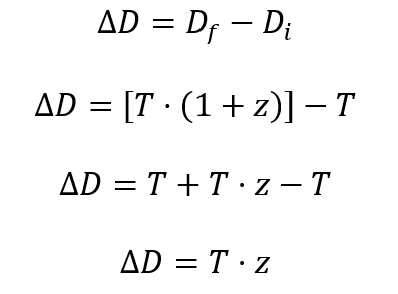
Applying the fundamental kinematic definition of average velocity as the ratio of accumulated space over elapsed time, we obtain:
V_m = \Delta D / T = (T * z) / T
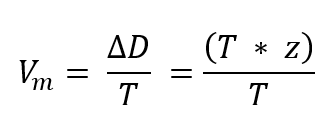
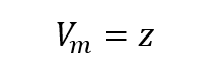
By canceling the time variable T from both the numerator and the denominator, the algebraic breakdown yields:
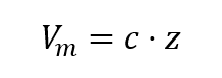
When expressed in standard cosmological units relative to the constant speed of light (c), the equation reaches its definitive, closed form:
V_m = c * z
Acknowledgments
This paper was developed in independent research and compiled in computational collaboration with Artificial Intelligence (AI) systems applied to mathematical and cosmological verification.